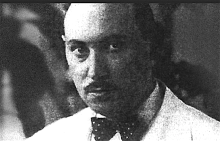
Rudolf Fränkel [also known as Rudolf Fraenkel, and as Rudolph Frankel] was born in Neisse [now Nysa], Poland, on 14 June 1901 and was the son of Louis Fränkel, an architect. After leaving school, his further education was interrupted by the outbreak of World War One in which he served in the Luftstreitkräfte (Imperial German Air Force). With the war over, he enrolled at the Technische Hochschule in Berlin - Charlottenburg in 1918 where he trained as an architect until 1922. From 1922 to 1924 he worked in the office of Richard Riemerschmid in Munich and with Gustav Hart in Berlin. He then opened his own office in Berlin.
His first substantial commission was a housing and entertainment complex named “Gartenstadt Atlantic", which is considered a prime example of Neues Bauen. He was soon recognised as a rising star among German architects and his work was wide covered in the German and international architectural press.
In 1925 he became a member of the Bund Deutscher Architekten (BDA) and the following year he joined the Deutscher Werkbund.
When the National Socialists came to power in Germany in 1933, effectively he was banned from practising as an architect because he was Jewish. In the summer of that year he moved to Bucharest, Romania where he continued to work as an architect until 1937 when he moved to England. He settled in London and became an active member of the émigré community. He was also able to continue working as an architect, although at the outbreak of World War Two, he was briefly interned as a potential enemy alien. In 1943 he was a founder member of the "Circle", a group of German and Austrian Architects and Engineers and in 1945 became a member of the Architects for the Redevelopment of Distressed Areas. 1948 he was elected a Fellow of the Royal Institute of British Architects (FRIBA).
In 1950 Fränkel emigrated to the USA where he remained for the rest of his career as an architect. From 1950 to 1968 he taught at Miami University in Oxford, Ohio
He died in Oxford, Ohio, on 23 April 1974.
A biographical file on Rudolf Fränkel is available at the Enquiry Desk, Royal Institute of British Architects Library, London.
Notable architectural projects by Fränkel in Germany included the Gartenstadt Atlantic complex in Berlin-Gesundbrunnen (1924-28); a residential development at Emser Straße 14-17a in Berlin-Wilmersdorf (1926); the residence of the film director Gabriel Levy (1881-1965) at Silberberger Straße 29a in Bad Saarow (1926-28); the Honig residential complex at Bellermannstraße 72-78, Gesundbrunnen, Berlin (1927); the Lichtburg cinema at Gartenstadt, Berlin-Gesundbrunnen (1927-29); one- and two-family houses in the garden city of Frohnau in Berlin-Frohnau (1927-30); the Ruhr bridge in Schwerte-Westhofen (1928); a two-family house at Warnemünder Straße 28a/b in Berlin-Dahlem (1929); the Lange housing complex in Bad Saarow (1929-32); an apartment building at Grieser Platz in Berlin-Halensee (1930); the Leuchtturm Restaurant at Friedrichstraße 138 in Berlin-Mitte (1930-31); a residential development at Stadtpark Schöneberg in Berlin-Schöneberg (1930-32); the Stern residence in in Schmolz, near Breslau (1931-32); and the renovation of the Albert Schumann Theatre in Frankfurt am Main (1932-33).
Architectural projects by Fränkel in Romania included the Pop residential building at Caragiale 9, Bucharest (1933-34); a steel works in Otelu Rosu (1934); the Adriatica Asigurarea building in Bucharest (1933-35); a silk-weaving mill near Bucharest (1934-36); the Teatrul de Comedie (Komödien-Theater) in Buchest (1935-36); the Scala Cinema in Bucharest (1935-37); the Malaxa apartment building in Bucharest (1935-37); and the Flavian house in Bucharest (1936-37).
Architectural projects by Fränkel in England included the Rachwalsky House in the Home Counties for his sister and her husband and a house for himself in London (1937-38); and a private residence in Stanmore, near London (1949). Between 1941 and 1950 he also designed industrial buildings for E. H. Jones (Machine Tools) Ltd. in Kingsbury, London; Suflex Ltd.; Sotex Ltd. in Congleton, Cheshire; and Luralda Ltd. in London.
During his years in the USA Fränkel focused almost exclusively on city planning and teaching. He was appointed Planner-in-Charge for Ohio, and worked as consultant for the Public Housing Administration.
Benton, Charlotte. A different world : emigre architects in Britain 1928-1958. London : RIBA Heinz Gallery, 1995.
Brown-Manrique, Gerardo.Rudolf Fränkel and Neues Bauen: Works in Germany, Romania and the United Kingdom. Tübingen: Wasmuth, 2009
Hill, Noel E. ‘Don't forget Frankel, visionary Prussian’. Architects' Journal vol. 205, no. 10, 13 March 1997 p. 26
Hill, Noel E. ‘Don't forget Frankel, visionary Prussian’. Architects' Journal vol. 202, no. 9, 7 September p. 20
Powers, Alan. Modern. The Modern Movement in Britain. London: Merrell, 2005
Rudolf Fränkel, die Gartenstadt Atlantic und Berlin. Edited by Gerwin Zohlen. Sulgen: Verlag Niggli,, 2006
Schatzke, Andreas. Deutsche Architekten in Grossbritannien : Planen und Bauen im Exil 1933-1945 = German architects in Great Britain : planning and building in exile 1933-1945 / Andreas Schatzke ; unter Mitarbeit von Meike Schultz. Stuttgart ; London : Axel Menges, 2013.
Stahl, Fritz. ‘Neue Arbeiten von Rudolf Fränkel’. Moderne Bauformen, vol. 27, 1928 pp. 249–260
Yakobson, L. N. ‘House for a Writer. [House by Rudolf Fränkel] Decoration [UK] no. 22 [new series], February 1937 pp. 20-24
Yakobson, L. N. ‘The House of the Month. The Growing House’. [House by Rudolf Fränkel] Decoration [UK] no. 9 [new series], January 1936 pp. 14-15
‘A new home for the elderly in Berlin’ [Architect: Rudolf Frankel] Monatshefte fur Baukunst & Stadtebau vol. 14, 1930 p.459
‘Architecture for industry by Rudolf Frankel: (1) Machine shop, Birmingham; (2) Nylon factory, Congleton’ Progressive Architecture no. 4, 1951 pp. 81-88
‘Cinema and offices, Bucharest’ [Architect: Rudolf Frankel] Architects’ Journal 30 June 1941 p. 79
‘Cinema and offices, Bucharest’ [Architect: Rudolf Frankel] Architects’ Journal 30 January 1941 p. 79
‘Contemporary furniture; Designed by: Vittoria Lombardi of Milan and Rudolf Frankel’ Wood, February 1948 pp. 34-36, 48-49.
‘Early example of northlight shell construction: Sotex knitted clothing factory at Congleton, Cheshire’ [Architect: Rudolf Frankel] Civil Engineers' Review May 1953 p. 194
‘Flats: various blocks in and near Berlin’ [: R. Frankel] Building January 1947 pp. 9-16.
‘From circus to cinema - an evolution in entertainment: conversion of large Frankfurt-am-Main circus to theatre seating 3,000’ [Architect: R. Frankel] Building February 1946 pp. 42-47
From circus to cinema - an evolution in entertainment: conversion of large Frankfurt-am-Main circus to theatre seating 3,000’ [Architect: R. Frankel] Building March 1946 pp. 84-86
‘Knitting and clothing factory at Congleton, Cheshire’ [Designed by: Rudolf Frankel] Architects' Journal 30 June 1949 pp. 588-591
Mill (velvet-weaving) near Bucharest’ [Architect: Rudolf Frankel] Architects’ Journal 10 April 1941 p. 246
‘Risca, South Wales’ [Architect: R. Frankel] Architects’ Journal 14 April 1949 pp. 343-345
‘Risca, South Wales’ [Architect: R. Frankel] Architectural Review April 1949 p. 172
‘Small house, Stanmore’ [Architect: Rudolf Frankel] Architects' Journal 28 November 1940 pp. 439-441
‘Small house, Stanmore’ [Architect: Rudolf Frankel] Architectural Review 29 November 1940 pp. 136-137, 157
‘The growing house’ [Architects: Rudolf Frankel] Viviendas vol. 2, July 1933 pp. 10-11 [Text in Spanish]
‘The Schumann-Theater in Frankfurt’ [Architect: Rudolf Frankel] Monatshefte fur Baukunst & Stadtebau vol. 17, February 1933 pp. 57-66